
LLMs & cultural evolution
LLMsCultural EvolutionMulti-Agent SystemsWhat can LLMs bring to the study of cultural evolution 🤔? This started as our project at the Hack1Robo 2023 hackathon: simulate text evolution in populations of LLMs, and analyze the resulting dynamics, inspired by works in cultural evolution. With Jérémy Perez and the Flowers team, we kept working on it after the hackathon, and it grew into two papers.
Cultural evolution in populations of LLMs (2024)
In this first paper, we present a framework for simulating cultural evolution using LLMs 🦜. We study how the dynamics depend on social structure, simulated personalities 👥, and whether they have potential attractors 🧲.
Cultural evolution research aims at explaining how culture changes over time. Computational models have been very successful at testing the effect of factors such as population structure or transmission biases, but some phenomena are hard to capture with agent-based and formal models, in particular how evolved cognitive mechanisms transform social information. Leveraging the capacity of LLMs to mimic human behavior can help fill this gap. And as artificial agents take a growing part in the evolution of culture, machine-generated cultural evolution is also worth studying for its own sake.
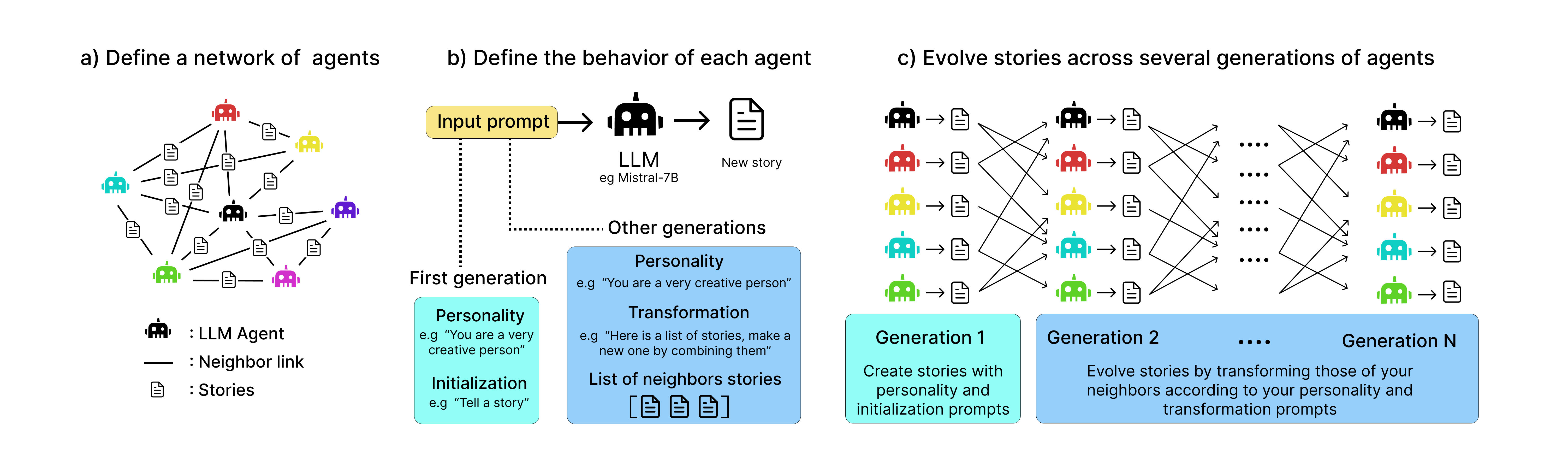
The framework lets you manipulate variables known to matter in cultural evolution: network structure, personality, and the way social information is aggregated and transformed. I co-developed the open-source LLM-Culture library behind it, which comes with an intuitive web interface, to help build bridges between cultural evolution and generative AI.
When LLMs play the telephone game (ICLR 2025)
What happens when LLMs play the Telephone game ☎️? In this second paper, we analyse the evolution of texts as they are transmitted between LLM agents 🤖💬🤖💬🤖. Do text properties converge to attractors 🧲? How is this influenced by the task 📝 and the model ⚙️?
As LLMs interact with each other and generate more and more text online, it becomes crucial to understand how information is transformed as it passes from one LLM to the next. Small biases, negligible in a single output, can be amplified over iterated interactions. We use a transmission chain design borrowed from human cultural evolution: each LLM agent receives a text, produces a new one, and passes it to the next agent.
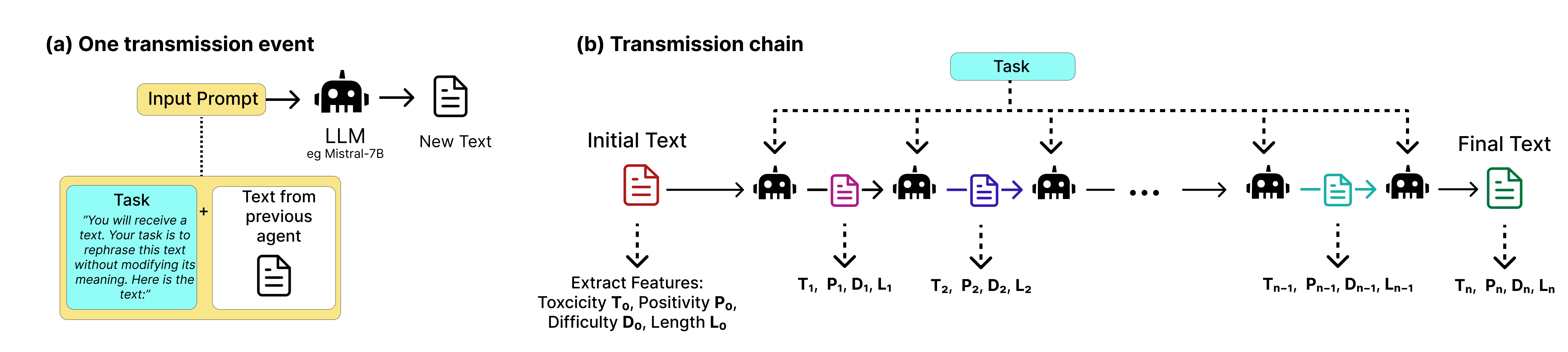
Tracking toxicity, positivity, difficulty and length along the chains, we uncover biases and attractors that depend on the initial text, the instructions, the model and its size. More open-ended instructions lead to stronger attraction than constrained ones, and toxicity shows stronger attractors than length. Evaluating LLMs one output at a time misses these multi-step dynamics.