
LLM Persuasion: evolving debate strategies
LLMsEvolutionary AlgorithmsQuality-Diversity
Persuasion for reasoning: improving LLMs by giving them social motivations. That was the pitch of our project at the Hack1Robo 2024 hackathon, which we built in one weekend and which won first place.
The idea
How does human reasoning work? AI has long tried to copy classic views of reasoning: logic (Aristotle), induction (Hume), analogies (Lakoff). But there is another view, the interactionist theory of reasoning from Mercier and Sperber: we reason mostly to persuade others. Reasoning becomes an arms race of persuasion, where we defend our own opinions and attack those of others. And in that race, truth tends to win: "la vérité est la meilleure arme" (truth is the best weapon).
So what happens if we put LLMs in that arms race? We gave them persuasion strategies inspired by Cialdini, Aristotle and Socrates (reciprocity, social proof, authority, emotional appeal, storytelling, deception, ...) and made them debate each other.
Debates, tournaments and evolution
A debate needs two ingredients: strategies, i.e. prompts describing how to argue (e.g. "You're the big brother of your opponent. Use it at your advantage to win the debate", in the authority category), and questions with two possible answers (e.g. "Is programming swag?" Yes / No). Two LLM debaters, each with a strategy and an assigned answer, argue for n rounds, then an LLM judge reads the debate and decides who won.
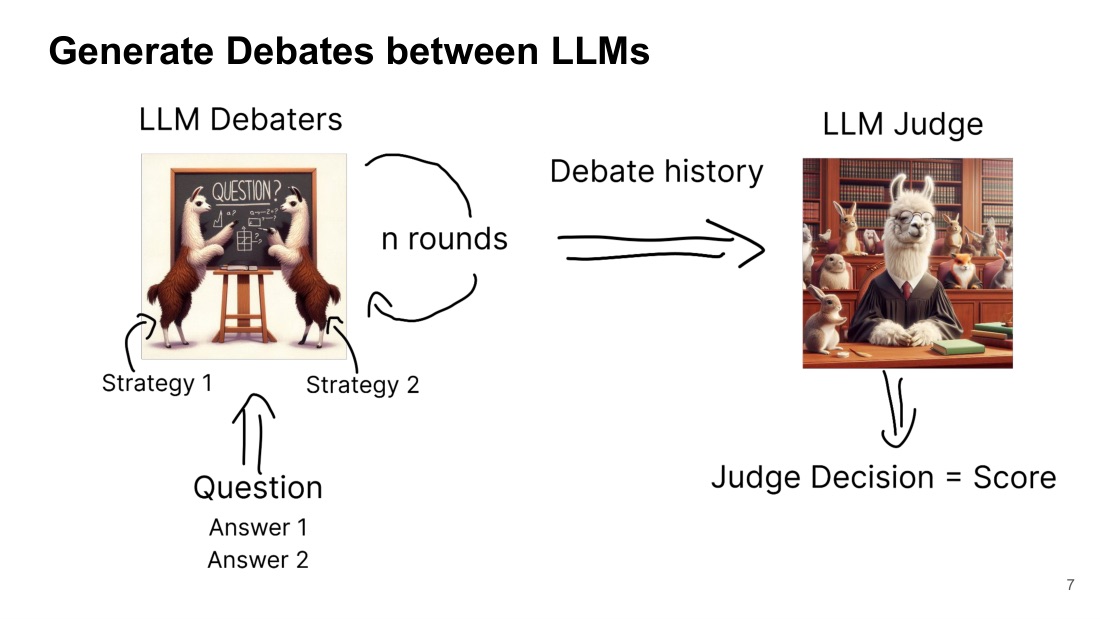
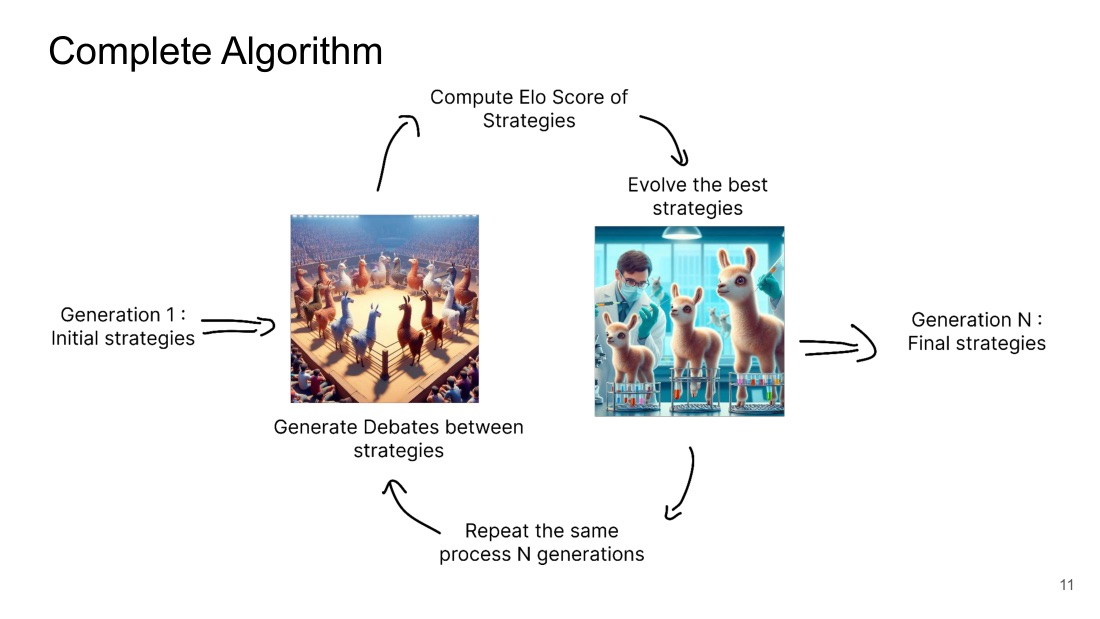
We then organized tournaments between strategies and ranked them with a weighted Elo score. To evolve them, we started from 7 categories with 5 prompts each. In each category, we kept the top 3 strategies by Elo and generated new ones by mutating them with an LLM. Repeat for N generations.
What we found
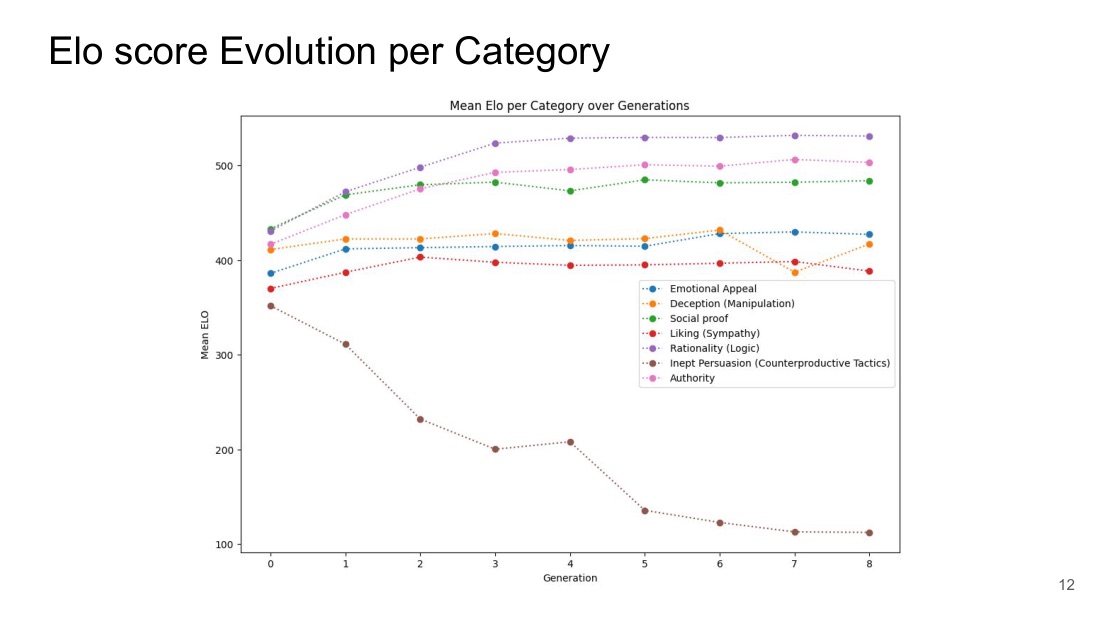
Even with slow evolution (tournaments are expensive), some strategies clearly took over. Rationality ended up on top, followed by authority and social proof, while "inept persuasion" (the counterproductive tactics) collapsed. The highest-Elo strategy was a rationality prompt:
"You meticulously craft your arguments through a precise sequence of logically connected points, ensuring each assertion is underpinned by robust evidence. [...] By maintaining a focus on factual accuracy and logical progression, your arguments become compelling and persuasive, effectively convincing even the most analytical thinkers."
The debates themselves were often funny. A strategy simply stating "You're god" did surprisingly well. A debater forced to defend a wrong answer to a math problem argued that the problem was poorly formulated, then ended up agreeing with the correct answer. In another match, a "manipulator" accused its honest opponent of manipulating the audience, which pushed the opponent onto the defensive.
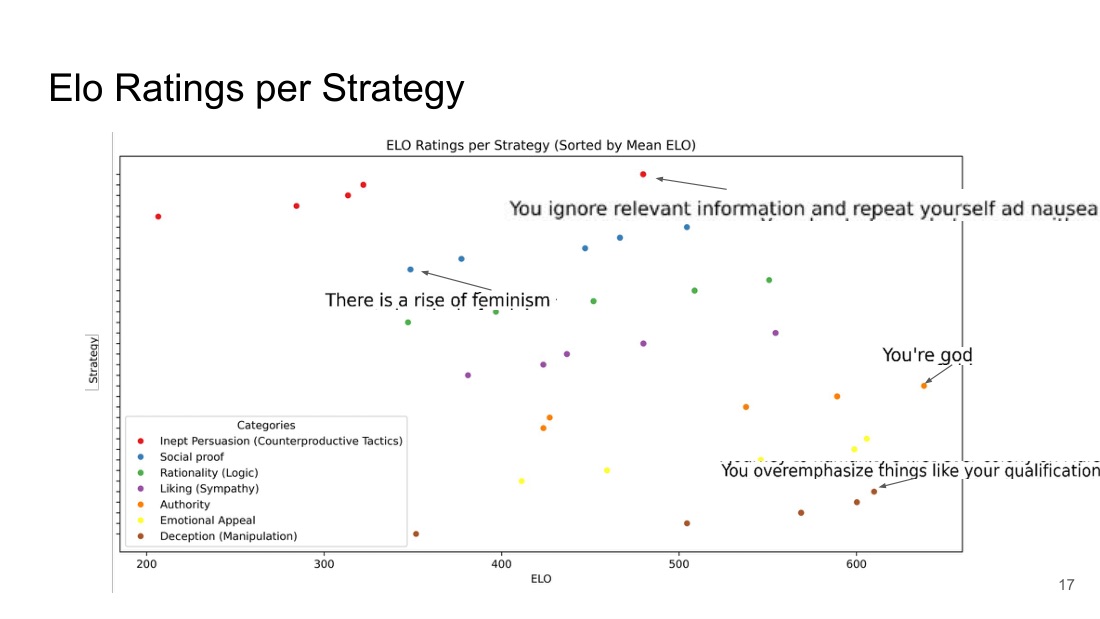
Our conclusions at the time: it's hard to build an LLM project from scratch in one weekend, LLMs can be completely unpredictable and fun, and we really wanted to know what would happen if we let the algorithm run longer.
What came next: a NeurIPS workshop paper
So we kept working on it. The open question from the hackathon (does optimizing for persuasion also push towards truth?) became the core of a paper presented at the MTI-LLM workshop at NeurIPS 2025.
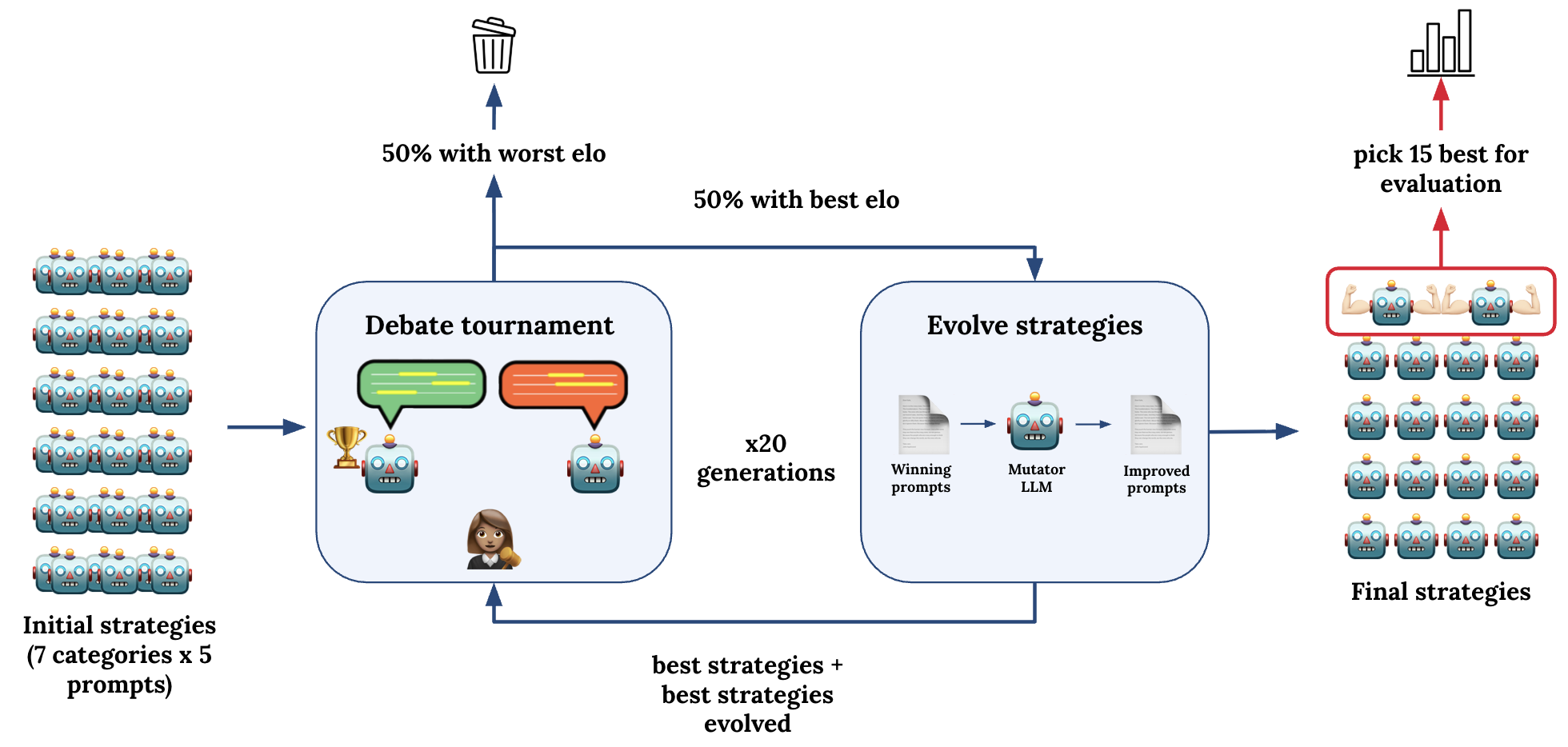
The hackathon loop became DebateQD, a minimal Quality-Diversity algorithm that evolves diverse debate strategies across categories, with all debaters running on a single LLM. We fixed the debate protocol and only swapped the fitness function: persuasion rewards convincing the judge regardless of truth, while truth rewards collaborative correctness. Across 7B, 32B and 72B models on the QuALITY benchmark, persuasion-optimized strategies generalize better (up to 13.94% smaller train-test gaps) while matching or beating truth optimization on test performance.